2025 · Mobile, distributed backend and infrastructure
Yoma
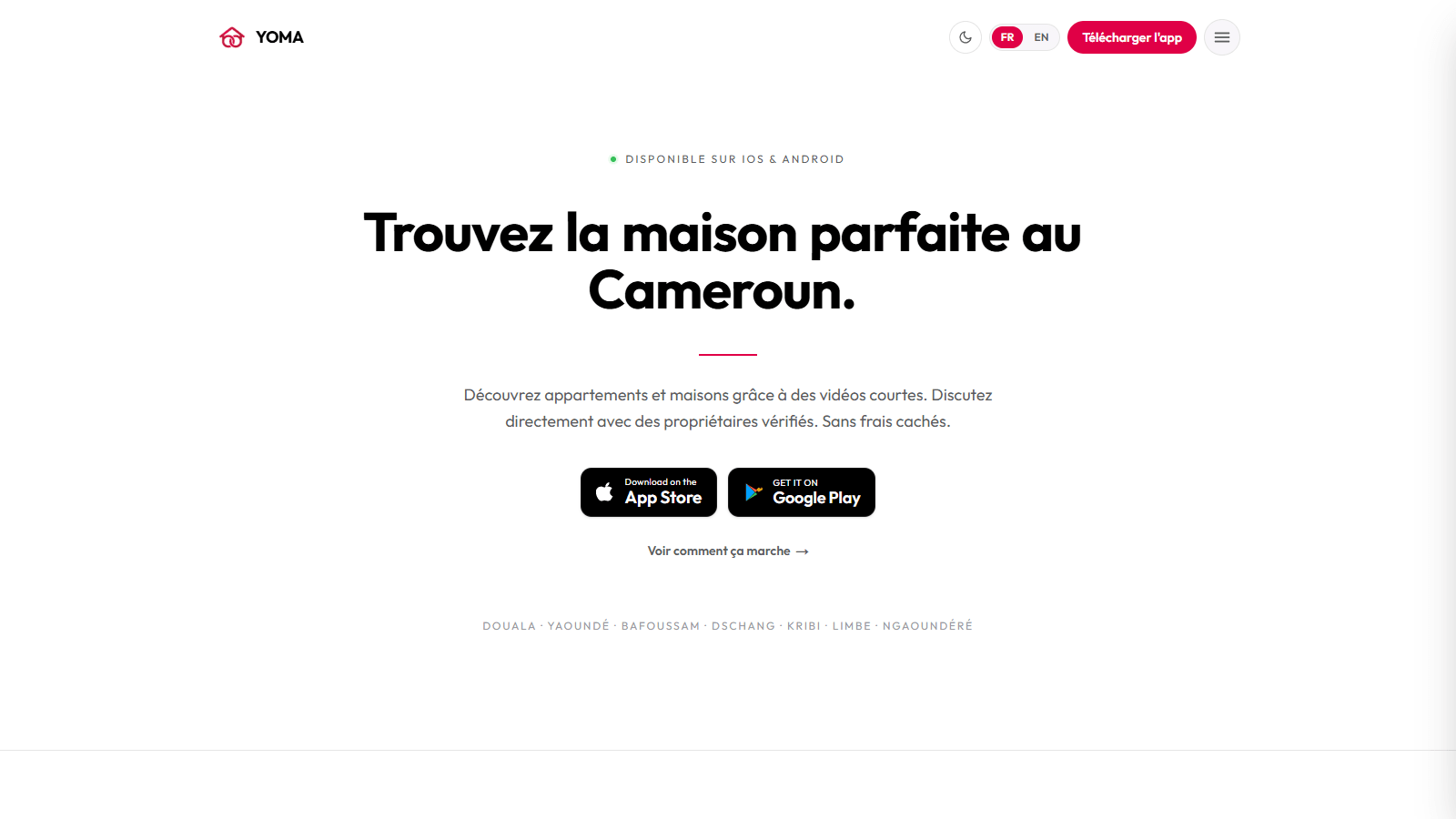
A photograph flatters. Sixty seconds of video walking through a flat does not. Yoma makes video the listing, then does the tedious part of house hunting on the renter's behalf.
- 5
- backend services, event driven
- 60s
- of vertical video per listing
- 7
- cities covered
- 3
- databases, each for one job
The problem
Renting in Douala or Yaoundé means WhatsApp photos taken at flattering angles, agents who cost you an afternoon, and a trip across town to discover a place is nothing like its pictures. The wasted journey is the actual cost of the current system.
It is also asymmetric work: the renter has to contact every landlord one at a time, and most never reply.
What it does
- Listings are up to sixty seconds of vertical video, not a gallery. You see the corridor, the water pressure, the street outside.
- Search on a Google Maps view with filters that apply live, because in a city the question is always where before it is what.
- An AI assistant reads the search and messages the five best matching landlords on the renter's behalf, so one search starts five conversations.
- Direct secure chat between renter and landlord once contact is made.
- Every landlord is verified by an admin before a listing can go up.
- Douala, Yaoundé, Bafoussam, Dschang, Kribi, Limbe and Ngaoundéré.
- An admin panel carrying the verification queue, listings, moderation and users.
How it is built
- Five NestJS services: gateway, core, media, notifications and chat.
- Completely event driven over BullMQ queues. Video transcoding, notification fan-out and AI matching all happen off the request path, because none of them should make a renter wait and all of them can fail and be retried.
- Postgres for listings, users and everything that has to be consistent. Redis for caching and as the queue backbone.
- MongoDB behind the chat service and nowhere else. Chat is the one part of this system with a fundamentally different shape: enormous write volume, append mostly, read by conversation. Giving it its own store keeps that load away from the database the listings depend on.
- Media is its own service for the same reason: transcoding is CPU bound and bursty, and it must never be able to slow down a search.
Infrastructure
- All five services containerised with Docker on a dedicated VPS, provisioned and maintained solo.
- Splitting the backend was a decision about failure, not fashion: the parts that can be slow are the parts that are allowed to be slow, and they cannot take the rest down with them.
Stack
- React Native
- NestJS
- BullMQ
- Postgres
- MongoDB
- Redis
- Docker
- Google Maps
Other projects
Loxim
A flight simulation companion app for iOS and Android, used by more than 30,000 virtual pilots worldwide, with the United States, Germany, the United Kingdom and France among the largest.
Ya'Noo
A food delivery platform built for how Cameroon actually pays: Mobile Money, and a price you see before you tap order.
Zenithe Insurance
An insurance app where a client reads the policies, subscribes and follows the contract from their phone, built and run to ISO 27001 and ISO 9001 practice.